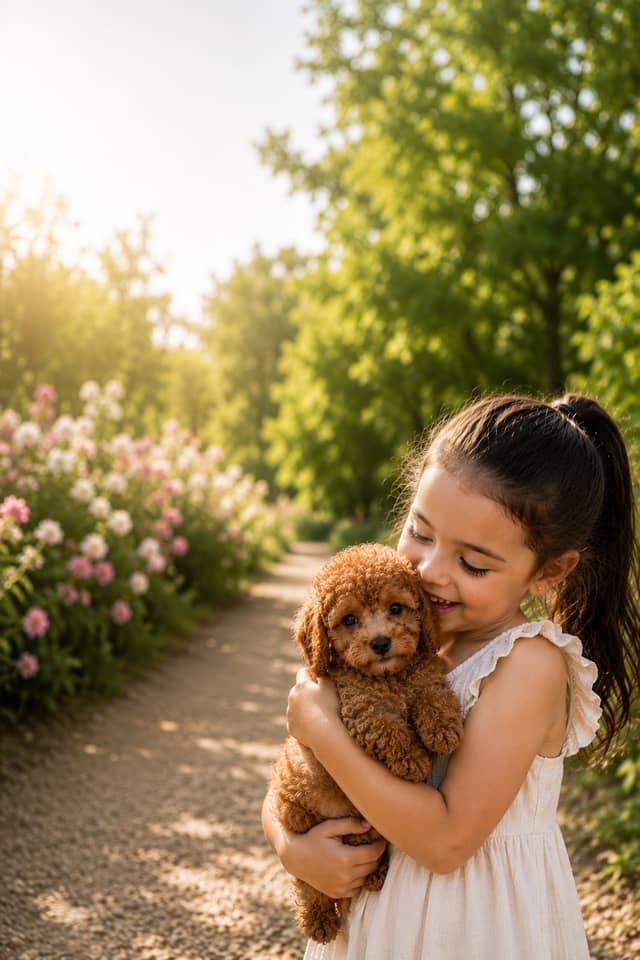

A large breed puppy is a small dog for a surprisingly short window. The Goldendoodle you can lift with one arm this month will, by next spring, lean his full weight against your shins while you cook dinner — and somehow that becomes your favorite part of the day. Big dogs ask for room to grow and a little patience early on. What they give back is presence: a calm, steady, unmistakable sense that the house is now fully occupied. At Wellspring Puppies, our large breed puppies come from a trusted network of carefully selected, licensed breeders, and they’re ready to meet you in person at either of our two Dallas–Fort Worth locations.
What Counts as a Large Breed Here
We group a puppy into the large category when it’s headed for roughly 50 pounds or more as an adult — and within that line there’s a wide spread. A Golden Retriever or Labrador settles in around 55 to 75 pounds. A Bernese Mountain Dog or Rottweiler runs 80 to 110. A Great Dane is its own weather system, sometimes north of 130. Doodle crosses land wherever their parents do, which is part of why people love them: a standard Goldendoodle or Bernedoodle can be a true big dog, while the mini lines stay smaller.
Size shapes everything that follows — how they grow, what they eat, how they cool off in a Texas July, and how much yard or apartment they genuinely need. None of it is complicated. It just rewards thinking a few months ahead.
The Temperament of a Big Dog
The reputation precedes them, and most of it is right. Large breeds tend to be confident without being frantic, affectionate in a grounded way, and deeply oriented toward their people. A German Shepherd watches the room and waits for a job. A Golden or a Lab greets the mail carrier like a long-lost cousin. The doodle crosses — Goldendoodle, Bernedoodle, Labradoodle — fold a Poodle’s quick mind into a softer, sturdier frame, which is exactly the combination so many DFW families are after.
What they share is a love of being part of things. These are not background dogs. They want to be in the kitchen, on the school run, underfoot during the game. Raised with consistent rules from the first week, that wiring makes them some of the easiest big dogs to live with. Skip the early structure and the same size that made them lovable makes a bad habit hard to walk back. The honest version: a large breed puppy is more dog to train, which is why it’s worth starting on day one.
Growing Up Right: Joints, Food, and Pace
Here’s the one thing large breed owners should internalize early — big puppies should grow slowly. Bones and joints need time to set, and pushing growth faster than the frame can handle is how genetically fine dogs end up with hip and elbow trouble. Three habits do most of the work:
- Feed a large-breed puppy formula, measured. These foods deliberately moderate growth and balance calcium and phosphorus, so don’t add supplements on top. Measure meals instead of leaving the bowl down; portioned puppies have lower rates of joint problems than free-fed ones.
- Keep exercise low-impact for the first year. A useful rule of thumb is about five minutes of structured activity per month of age, up to twice a day. Leash walks on grass, swimming, and short training games are ideal. Save the long pavement runs and repetitive jumping until growth plates close — usually 12 to 18 months.
- Hold a lean body weight. A trim large breed puppy carries less load on developing joints. Your vet can show you what lean looks like at each stage.
Every Wellspring puppy is examined by a licensed Texas veterinarian before meeting families, and we work with breeders who screen their breeding dogs for the heritable conditions that matter in big breeds. The slow-growth plan is the part that stays in your hands.
Coats, Shedding, and Texas Grooming
Large breeds span the full coat spectrum, and it’s worth knowing which camp you’re joining. The double-coated group — German Shepherds, Bernese Mountain Dogs, Golden Retrievers, Siberian Huskies — sheds genuinely, and twice a year it sheds dramatically. In DFW’s heat that coat is doing real work as insulation, so resist any urge to shave it; brush it instead, two or three times a week, more during the seasonal blowouts.
The doodle and Wheaten-type coats — Goldendoodle, Bernedoodle, Labradoodle, and the Wheaten itself — shed far less, which is the draw for families with mild allergy sensitivities. The trade is maintenance: those coats mat without regular brushing and a professional groom every four to eight weeks. Either way, plan for grooming as a standing line in the budget, not a surprise. A big coat is a big commitment, and the right tools at home cut the workload in half.
Energy and Exercise, by Type
“Large” is not a single energy level, and matching the dog to your real schedule matters more than the number on the scale.
- High-drive: Australian Shepherds and Siberian Huskies need vigorous, daily, mind-and-body exercise regardless of how big your home is. Under-exercise them and you’ll meet a redecorator.
- Steady and adaptable: Golden Retrievers, Labradors, and most doodle crosses are happy with a solid daily walk plus play, then a long nap on the cool tile.
- Surprisingly low-key: English Bulldogs and even Great Danes are famous couch occupants once grown — short walks suit them, and the Bulldog in particular should never be over-worked in the heat.
Mental exercise counts as much as physical for the smart ones. Puzzle feeders, scent games, and ten focused minutes of training will settle a sharp puppy faster than another lap around the block.
Is a Large Breed Right for Your Home?
Big dogs fit more homes than people expect — including apartments — but they fit some better than others. You’ll do well with a large breed if there’s an adult who can commit to daily walks, you don’t mind sharing the couch, and a higher feeding and vet budget doesn’t faze you (a 90-pound dog simply costs more to keep than a 9-pound one).
A fenced yard is a convenience, not a requirement. A committed walker in a North Dallas apartment will raise a more contented Lab than a busy family with a yard nobody uses. What every large breed needs is time and inclusion — they were bred to be with you, and that’s the non-negotiable. If your days are long and empty of the dog, choose a lower-drive breed and lean on midday help.
These pages are a good place to look harder at the front-runners: the friendly, low-shedding Goldendoodle, the tri-color, family-soft Bernedoodle, or the easy-going Labradoodle. You can also browse every puppy we have for sale to see who’s actually in the building this week.
Health Notes Worth Knowing Early
A few conditions come up more often in big breeds, and knowing them up front makes you a calmer owner, not a worried one.
- Hip and elbow dysplasia — common talking points for Shepherds, Labs, Goldens, and doodle crosses. Genetics set the stage; the slow-growth plan above is your lever.
- Bloat (gastric dilatation-volvulus) — a real risk for deep-chested breeds like Great Danes and Bernese Mountain Dogs. Feed two or three smaller meals a day and avoid hard exercise right around mealtime.
- Heat sensitivity — the double-coated and the flat-faced (the English Bulldog especially) both overheat faster than average and need shade and water on tap.
Schedule a vet visit in your puppy’s first week to set the vaccine and parasite schedule — fleas, ticks, and heartworm are year-round realities in this climate. For families who want backing behind the long stretch, an optional 15-Year Limited Health Warranty can be added in-person; think of it as something that stands behind the years ahead, not a promise about any single day.
Big Dogs in DFW Heat
This is the part North Texas owners can’t skip. From late spring into early fall, our humidity makes panting less effective — which means a big dog can slide toward heat exhaustion faster than you’d guess, especially the thick-coated and the short-nosed. The playbook is simple:
- Walk in the early morning or after the sun drops, not at midday.
- Test the pavement with the back of your hand; if it’s too hot for you, it’s too hot for paws. Pick grass and shade.
- Keep cool water and shade available at all times, and never leave a dog in a parked car, even for a minute.
- Brush double coats more often through summer so air can move against the skin.
Get the heat routine right and a large breed lives a long, comfortable Texas life. The Metroplex’s shaded trails and grassy parks are made for early-morning puppy outings once your young dog has the vaccinations and the leash manners to enjoy them.
See Them in Person at Either Location
The best way to choose a big dog is to stand next to a few of them. Our two locations — the North Dallas location on Inwood Rd, just off I-635, and the Fort Worth-area location in Mansfield on FM157 — show combined inventory, so a Goldendoodle you spot online may be waiting at whichever location is closer to you. Both are open seven days a week
Come meet them in person — that’s the part that matters. Plan a trip to the North Dallas location or the Fort Worth-area location, bring the whole family, and take your time. If you’re spreading the cost, we work with TerraceFinance in-person so the timing fits your life. One trusted breeder network, two DFW locations — and a clear answer to every question, so ask us anything.
Large Breed Questions, Answered
How big will a large breed puppy actually get?
It depends on the breed, but “large” here means an adult of roughly 50 pounds and up. Labs and Goldens commonly land in the 55–75 pound range, Bernese Mountain Dogs and Rottweilers in the 80–110 range, and Great Danes well beyond that. Standard doodle crosses like a Goldendoodle or Bernedoodle can be true big dogs, while mini lines stay smaller — ask us about a specific puppy’s expected adult size when you visit.
When does a large breed puppy stop growing?
Most reach full adult size between 12 and 24 months, and the very largest breeds, like Great Danes, can take the full 18 to 24 months to finish. Growth plates generally close between 12 and 18 months. Even a puppy that looks nearly grown at 8 or 10 months is often still filling out, so keep feeding a large-breed puppy formula until your vet recommends the switch to an adult diet.
Can a large breed puppy live in a DFW apartment?
Yes, more easily than most people assume — provided it gets daily structured exercise and plenty of time with you. A committed walker can raise a perfectly happy Lab or Goldendoodle in an apartment. High-drive breeds like Australian Shepherds and Huskies need more vigorous daily activity regardless of square footage, while English Bulldogs and grown Great Danes are often calm indoors. A yard helps but isn’t required.
How do I keep a big puppy safe in the Texas summer?
Walk in the early morning or evening, avoid hot pavement, and keep cool water and shade available at all times. Double-coated breeds (Shepherds, Bernese, Huskies) and flat-faced breeds (English Bulldogs) overheat fastest and need extra care. Never shave a double coat for summer — brush it more often instead, since it insulates against heat as well as cold.
Which large breed health issues should I plan for?
The ones large breeds discuss most are hip and elbow dysplasia and, in deep-chested breeds, bloat. Joint conditions have both genetic and environmental sides, so a large-breed puppy diet, low-impact exercise in the first year, and a lean body weight all reduce risk. Every Wellspring puppy is examined by a licensed Texas veterinarian before going home, and an optional 15-Year Limited Health Warranty can be added in-person.
Is financing available for a large breed puppy?
Yes. We work with TerraceFinance in-person, so qualified buyers can spread the cost over manageable monthly payments — approval is through TerraceFinance, not guaranteed. Ask our team when you visit either location and we’ll walk through the options together.