Nobody warns you that the hardest part of a new puppy isn’t the training itself — it’s the math. A puppy’s bladder runs on a clock you can’t see, and most of the early “accidents” are really just missed windows. Once you can read that clock, potty training a puppy stops feeling like a battle of wills and starts feeling like a routine you both settle into. This guide walks through how to do that without scolding, without panic, and without expecting a ten-week-old to behave like a grown dog.
Read the Bladder Before You Read the Dog
The single fact that fixes most of the frustration: a puppy can hold its bladder for roughly one hour per month of age, plus one. A two-month-old maxes out around three hours; a four-month-old, around five. Those are ceilings, not promises — excitement, water, and a full belly all shorten the window.
That math has two consequences worth sitting with. First, a very young puppy may need to go out a dozen times a day, and that’s normal, not a sign anything’s wrong. Second, you are not training the bladder to grow — it grows on its own. Your only job is to make sure the right spot is where they happen to be when the urge arrives. Get the timing right and the “training” mostly takes care of itself.
Small breeds — the Yorkies, Maltese, and teacup-size dogs that DFW families love — carry smaller tanks and often need a few extra weeks of patience. That’s biology, not stubbornness.
A Rhythm That Repeats Itself
Forget rigid hourly alarms. What actually builds a habit is tying potty trips to the things that already happen in a day, so the routine carries itself. Take the puppy to the same outdoor spot:
- The moment they wake up — from overnight sleep and from every nap. A sleeping puppy is a filling puppy.
- Within 15–30 minutes after eating. Three smaller meals beat one big one; more meals means more predictable trips.
- Right after a play session. Movement and excitement speed everything up.
- Last thing before bed, first thing in the morning. These two bookends protect your nights and your floors.
Use one short cue every time you arrive — “go potty,” “outside,” whatever you’ll remember to say half-asleep. The instant they finish, the reward comes there, in the spot, not after you’ve walked back inside. A treat delivered ten seconds too late teaches the wrong lesson; a treat delivered on the spot teaches “this is the place good things happen.”
Keep a One-Week Log
The fastest shortcut isn’t a product — it’s a notebook. For the first seven days, jot down when your puppy eats, drinks, naps, plays, and goes. By day three or four a pattern jumps off the page: maybe she always needs out twenty minutes after breakfast, or right at the end of an evening play session. Once you can predict the urge, you beat it to the door, and you stop relying on luck. After that week, you usually won’t need the log again.
The Spot, the Cue, the Cleaner
Three small things quietly decide how fast this goes.
One spot, always. Mixed locations send mixed signals. Pick a single patch of grass and return to it every time until the habit is solid.
The same cue, every trip. Consistency in the word matters as much as consistency in the place.
An enzyme cleaner on every accident. This is the one most people get wrong. A dog can smell residual scent far better than you can, and a spot that still smells “used” reads as an invitation to use it again. Standard household cleaners mask the odor for your nose but leave the marker for theirs. Skip anything ammonia-based — to a dog, ammonia smells like urine, which is exactly backward. Enzyme cleaners break the scent down at the source.
Where the Crate Fits
A crate isn’t a cage and it isn’t required — but it’s the most reliable tool you’ll find, because it leans on instinct: dogs avoid soiling where they sleep. Size it so the puppy can stand, turn, and lie down, and no larger. Give them a guest suite and they’ll simply pick a far corner as the bathroom. Use a divider that moves as they grow.
If you’d rather skip the crate, you can — but you trade it for closer supervision, more frequent trips, and a smaller gated area so you can catch the early tells: sniffing the floor, circling, a sudden pause mid-play. Those signals are your warning siren. Scoop them up and head for the door.
Living in an Apartment? You Have Options
A backyard is convenient, not mandatory. Plenty of puppies are house-trained in apartments and townhomes across Uptown, the Fort Worth Cultural District, and the newer builds in Frisco and Mansfield. A few adjustments make it work:
- Budget for the trip down. From a fourth-floor walk-up or a slow elevator, the route to grass eats minutes you may not have. Carry a young puppy to the ground floor at first rather than racing the clock through a hallway.
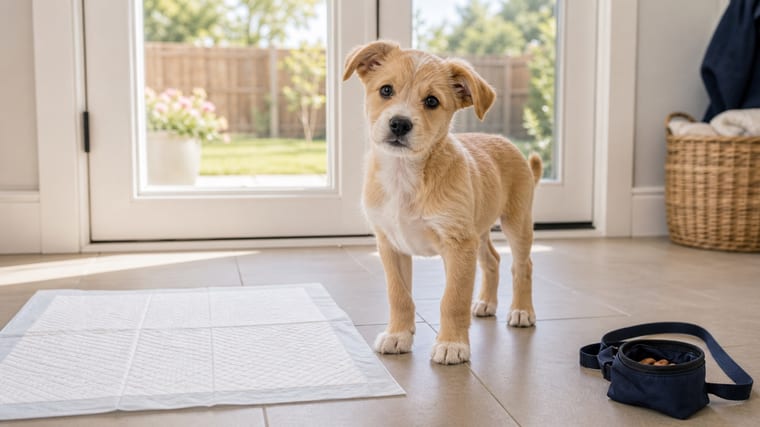
- An indoor backup, used as a bridge. A pad or a real-grass tray near the door buys you time while bladder control catches up, then you wean off it as outdoor trips become reliable. Treat it as training wheels, not a permanent destination.
- Borrow the rhythm of your own day. Hybrid and in-office schedules both work — anchor trips to your coffee, your lunch, your evening walk. The puppy syncs to your routine faster than you’d guess, and DFW has no shortage of greenbelts and dog-friendly trails to make that walk pleasant most of the year.
When You Can Call It Done
There’s no certificate, but the signs are clear. You can relax when your puppy:
- goes a full month with no indoor accidents,
- tells you they need out — a paw at the door, a stare, a small whine,
- waits when you ask them to hold it for a minute,
- returns to the same spot on their own,
- and sleeps through the night clean.
Most dogs hit this somewhere between four and six months when the routine started early and stayed consistent. Small breeds may take a little longer. If a puppy past six months is still having regular accidents despite a tight routine, it’s worth a vet visit — urinary tract infections and other quiet medical issues can look exactly like a training problem, and they’re more common in young dogs than people expect.
What Trips People Up
A few honest mistakes slow nearly everyone down at least once:
- Correcting after the fact. If you didn’t catch it in the moment, the puppy can’t connect your reaction to the act. You just teach anxiety. Clean it, tighten the schedule, move on.
- Granting freedom too early. A puppy loose in the whole house is an accident waiting for a quiet room. Expand their territory slowly, as the clean streak earns it.
- Treating a setback as failure. A regression after a move, a schedule change, or a growth spurt is ordinary. Go back to basics for a few days and it resolves.
The honest truth is that potty training is work — early mornings, repetition, the occasional 2 a.m. trip outside. But it’s finite. The puppy who feels impossible in week one is usually signaling at the door by month four.
Frequently Asked Questions
How long does potty training usually take?
Plan on about six months of consistent effort for full reliability, though it varies widely. Some puppies are dependable by four or five months; small breeds and puppies with rougher starts can take longer. Steadiness matters far more than speed — a calm routine kept up for months beats an intense push that fizzles in a week.
My puppy had an accident inside — what now?
If you didn’t see it happen, clean it thoroughly with an enzyme cleaner and let the moment go; a scolding after the fact only confuses them. If you catch them mid-act, interrupt gently — a clap or an “oops” — scoop them outside to finish, and reward there. The goal is to redirect, never to punish.
Can I potty train without a crate?
Yes, but it asks more of you. The crate works because puppies won’t soil where they sleep, so without one you’ll need closer supervision, more frequent trips, and a smaller confined space until the habit holds. Many families find the crate the path of least resistance for exactly that reason.
When will my puppy sleep through the night without a break?
Often by four to six months, sometimes sooner with a tight evening routine and a last trip right before bed. Puppies under twelve weeks will usually still need one overnight trip — their bladders simply aren’t there yet. Pull the water bowl an hour or two before bedtime to help.
Do small breeds really take longer?
Generally, yes. A teacup-size puppy holds less and processes faster, so the windows between trips are shorter and the timeline often stretches a few extra weeks. It’s not a discipline issue — it’s tank size. Plan for more frequent trips and a little more patience.
A Note Before You Start
The early weeks of any dog’s life set the tone for the years that follow, and a puppy that arrives already gently handled and socialized tends to settle into a routine faster. That’s the start we look for in every dog at Wellspring Puppies. If you’re still choosing a breed and wondering which fits an apartment or a busy household, our breed overview is a good place to begin — house-training is a little easier when the dog and the home are well matched from day one.