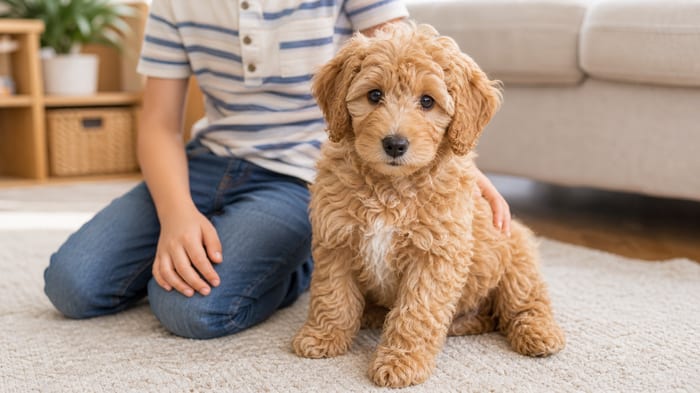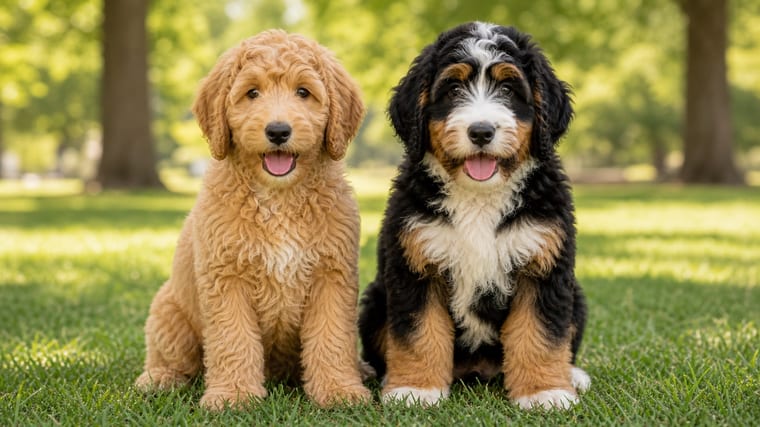
Both of these dogs share a Poodle parent, which is why families often lump them together as “a doodle” and stop there. But the second parent pulls them in genuinely different directions — one toward a bright, biddable retriever, the other toward a big, mellow mountain dog. Hold them side by side and the decision usually answers itself faster than people expect. Here’s how to read it.
Start With the Second Parent
The Poodle half is the constant. It’s where both breeds get their curl, their lower shedding, and a sharp, trainable mind. So the comparison isn’t really Poodle-versus-Poodle — it’s about who the other parent is.
A Goldendoodle is a Golden Retriever crossed with a Poodle: friendly, eager, tuned in to people, the classic American family dog wearing a softer coat. A Bernedoodle is a Bernese Mountain Dog crossed with a Poodle: a Swiss working breed known for being calm, steady, and devoted to its household, brought down a notch in shedding and often a notch up in trainability. Once you picture those two source dogs, most of the differences below stop being a spec sheet and start being a personality.
How Big Will It Actually Get?
This is the gap people feel first, and it’s the one Bernedoodles can stretch the widest. The Bernese parent is a genuinely large dog, so the Standard end of the Bernedoodle range runs heavier than most folks picture.
| Size class | Goldendoodle | Bernedoodle |
|---|---|---|
| Mini | ~15–35 lbs | ~25–49 lbs |
| Medium / Standard | ~50–90 lbs | ~70–90+ lbs |
| Typical lifespan | ~10–15 years | ~12–18 years |
A couple of things hide behind those numbers. A Bernedoodle’s “Mini” still tends to land sturdier than a Goldendoodle’s Mini — the Bernese frame doesn’t shrink as easily. And because smaller dogs generally outlive bigger ones, the Mini and Medium versions of either breed sit at the longer end of those lifespan ranges. Whichever you choose, you’re signing up for well over a decade together: the first chapter of a fifteen-year story, not a passing season. In a Dallas high-rise, a Mini of either breed is the realistic pick; on an acre out past Mansfield, a Standard Bernedoodle finally has room to be the bear it wants to be.
Energy: Two Speeds, Both Manageable
Neither of these is a hyperactive dog, but they idle at different RPMs.
A Goldendoodle carries the retriever’s cheerful drive. They’re up for a long walk, a fetch session, a swim, and another lap if you offer it — happiest with 45 to 60 minutes of real activity a day, then content to flop near you. They like having something to do.
A Bernedoodle tends to be the calmer of the two. The Bernese side brings a low-key, almost gentlemanly default setting; many are happy with a good daily walk and some yard time, then a long nap in the coolest room of the house. That mellow streak makes them easy company indoors — but don’t mistake calm for couch-bound. A young Bernedoodle still needs daily movement and a job for its mind, or that big body gets restless.
A quick gut check for a lazy North Texas Sunday: the Goldendoodle nudges you toward the door; the Bernedoodle is already asleep on the cool tile and perfectly fine waiting until evening.
The Grooming Reality Nobody Mentions Upfront
Here’s the part that surprises new doodle owners, and it’s identical for both breeds: the curl that keeps hair off your furniture is the same curl that mats if you ignore it.
Plan on brushing several times a week and a professional groom roughly every four to six weeks, year-round, for either dog. Two wrinkles worth naming:
- Coat type matters more than breed. A curlier, more Poodle-leaning coat sheds the least and feels the most “hypoallergenic,” but mats fastest. A wavier coat is more forgiving to brush but sheds a touch more.
- The Bernese coat runs thicker. A Bernedoodle, especially a Standard, can carry a denser, heavier coat than a Goldendoodle of the same size — which matters a great deal in a DFW summer (more on the heat below).
And the honest allergy note both breeds deserve: no dog is truly hypoallergenic. The proteins that trigger reactions live in dander and saliva, not just shed hair. Both shed far less than a purebred Retriever or a Bernese, and a multigenerational, curly coat is the most reliably low-shedding — but “low” is the honest word, never “none.”
Temperament Around Kids and Other Pets
Both breeds earn their family reputation, but they show up differently in a busy house.
Goldendoodles are outgoing and people-first. They tend to greet everyone — the kids, the neighbor, the delivery driver — like a long-lost friend, and they thrive on being in the middle of things. That sociability makes them forgiving of a loud, active household and quick to befriend a resident cat or dog.
Bernedoodles lean loyal and a bit more measured. The Bernese heritage often makes them devoted to their people, gentle with children, and a little more reserved with strangers at first — not shy, just observant. Their calmer default can be a real asset with toddlers and quieter homes. The trade-off: that loyalty can tip into needing more company, so a Bernedoodle left alone for long workdays may struggle more than an easygoing Goldendoodle.
For either breed, early socialization is the lever that matters most. Texas law keeps puppies with their litter until at least eight weeks, which gives them a head start on the social skills that make everything after easier.
A North Texas Factor: Heat and Coat
This is where the size and grooming differences turn practical. A heavier-coated Standard Bernedoodle feels a 102-degree Dallas afternoon more than a lighter Mini Goldendoodle does. It doesn’t rule the breed out, but it shapes the routine: walk early or after sundown, keep water and shade close, and keep the coat well-maintained, since a matted coat traps heat. Smaller, lighter doodles of either breed handle the summer with a bit more ease — one more reason the Mini versions are so popular in apartment-heavy parts of DFW.
Picking the One That Fits Your Days
Strip away the charts and it lands on a few honest questions:
- How much dog do you want, literally? Want a manageable companion that travels and fits a smaller space → Goldendoodle or a Mini Bernedoodle. Want a substantial, calm presence and have the room → Standard Bernedoodle.
- What’s your energy? Active household that’s outside a lot → Goldendoodle. Calmer home that wants a steady, devoted shadow → Bernedoodle.
- How full are your workdays? Long hours away tip toward the more independent Goldendoodle; the loyal Bernedoodle does best with company around.
- Do you have the grooming budget and time? Both demand it equally — so this one’s a tie, and a deal-breaker if the answer is no.
There’s no wrong pick here, only a better-fitting one. The dog that matches the life you actually live — not your idealized weekend — is the one that settles in and thrives.
See Them Side by Side in DFW
A breed chart can’t show you which puppy parks itself in your lap and refuses to move, or which one greets you at the gate. That’s the part worth seeing in person. We keep Goldendoodle puppies and Bernedoodle puppies in a range of sizes across our two DFW locations, and availability shifts daily as litters come and go. If you’re still weighing the wider doodle family, browse our full designer and hybrid lineup — then come meet them in person.
Quick Answers
What’s the main difference between a Goldendoodle and a Bernedoodle?
The Poodle parent is shared, so both are bright and low-shedding. The difference is the other parent: a Goldendoodle’s Golden Retriever side makes it outgoing and energetic, while a Bernedoodle’s Bernese Mountain Dog side makes it calmer, often larger, and more devoted to its household.
Which one is bigger?
Bernedoodles can get noticeably larger because the Bernese Mountain Dog is a big breed — Standards often run 70 to 90-plus pounds. Both come in Mini sizes, but a Mini Bernedoodle usually carries a sturdier frame than a Mini Goldendoodle of the same weight class.
Which doodle is better for a calm, quieter home?
Usually the Bernedoodle. Its mellow, loyal temperament suits a steadier household and is gentle around young children. Goldendoodles are wonderful family dogs too, but they bring more social energy and generally prefer to be in the middle of the action.
Do Bernedoodles and Goldendoodles handle the Texas heat?
Both can, but a heavier-coated Standard Bernedoodle feels DFW summers more than a lighter Goldendoodle. Walk in the cooler hours, keep water and shade nearby, and keep the coat well-groomed, since a matted coat traps heat. Smaller, lighter doodles cope a bit more easily.
Are they really low-shedding and good for allergies?
Both shed far less than a purebred Retriever or Bernese, and a curlier, multigenerational coat sheds the least. But no dog is truly hypoallergenic — reactions come from dander and saliva, not only hair — so spend time around the specific coat type before deciding.
Either of these dogs will give a DFW family years of good company. Spend an afternoon with each, watch how they settle, and let the right one make the case. When you’re ready, reach out and we’ll help.