Most people picture training as the part where a dog finally sits on command. The truth is gentler and a little slower than that. In those first weeks, you are not drilling tricks — you are teaching a young animal that your home is predictable, that good choices pay off, and that you are worth paying attention to. Get that part right and the cues follow almost on their own.
What’s Actually Happening in a Puppy’s Head
A puppy under four months old is mapping the world for the first time. Sounds, surfaces, smells, faces — all of it is being filed away as either “normal” or “alarming.” Training rides on top of that mapping. You are not installing software; you are shaping a young brain while it is still wide open.
This is why repetition and calm matter more than cleverness. A puppy learns by patterns: the same word, the same reward, the same outcome, over and over until it becomes a habit they barely think about. The flip side is just as real — confusion sticks too. If “off the couch” means yes on Tuesday and no on Friday, your puppy doesn’t learn the rule. They learn that the rule is a coin flip, and they stop listening for it.
So the first job isn’t a command at all. It’s deciding, as a household, what the rules are — where they sleep, where they go to the bathroom, whether furniture is allowed — and then everyone holding the line on the same words and the same answers. Boring? A little. But consistency is the whole engine.
The Quiet First Lessons (Before Any Real Cues)
Skip the formal commands for the first few days. There’s foundational work that comes first, and it’s easy to miss because it doesn’t look like training.
- Their name as a happy sound. Say it, and the second they look at you, mark it and reward. You’re teaching that turning toward you is always worth it. That single reflex underpins recall later.
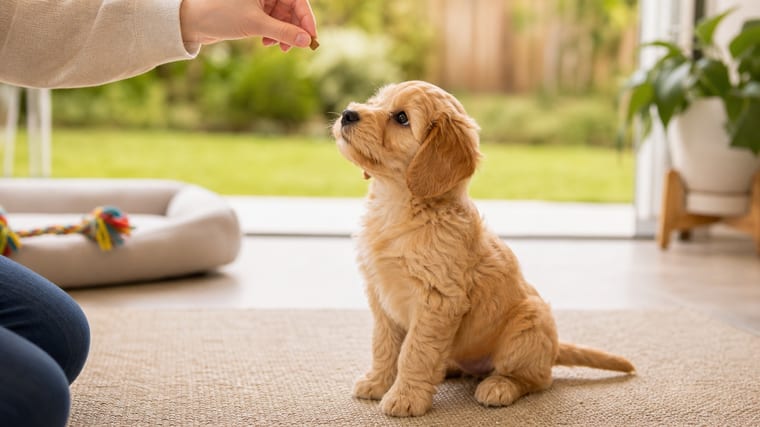
- A marker word. Pick one short word — “yes” works — and say it the instant your puppy does something right, then treat. The word becomes a camera shutter: it captures the exact behavior so your puppy knows precisely what earned the reward.
- Hand-feeding a few meals. Delivering kibble from your hand for a day or two builds the simple association that you are the source of good things. It does more for trust than any command will.
- Settling on a mat or in a crate. Reward calm, not just action. A puppy who can switch off and relax is far easier to live with than one who only knows how to be “on.”
These lessons feel like nothing. They are the soil everything else grows in.
The First Real Cues, in the Order That Works
Once your puppy is offering attention freely, layer in cues — one at a time, never a whole list in a week.
- Sit. Lure a treat up and back over the nose; the rear drops on its own. Name it the moment it touches the floor, reward, done. Most puppies have this in a day. It becomes your default “ask” for everything else.
- Touch. Hold out a flat hand; the instant the nose bumps it, mark and reward. This one is underrated — it’s a friendly way to move a puppy without pulling on them, and it builds the habit of coming toward your hand.
- Come. Crouch low, sound delighted, and reward like it’s the best decision they’ve ever made. Only ever practice indoors and close at first. Never call your puppy to do something they dislike, or “come” turns into a trap they learn to avoid.
- Leave it. Close a low-value treat in your fist; the moment your puppy quits at it, reward from the other hand with something better. You’re teaching that ignoring a temptation pays better than grabbing it — the foundation of every “don’t eat that” moment to come.
- Settle / down. Last, because it asks for stillness, which is the hardest thing for a baby dog. Lure from a sit down to the floor, name it, reward.
Two or three sessions a day, three to five minutes each, is plenty. End while your puppy still wants more. A short, winning session beats a long one that fizzles into frustration every single time.
Reward, Redirect, Repeat — Why Pressure Backfires
The method underneath all of this is simple: reward the behavior you want, calmly redirect the one you don’t, and never reach for fear. Decades of behavior research point the same direction — dogs trained with rewards learn faster and stay more confident than dogs corrected with intimidation.
Redirecting is its own skill. A puppy chewing your shoe isn’t being defiant; they’re a teething animal who found something chewable. Trade the shoe for a toy and reward the swap. Jumping on a guest? Turn away and reward the four-on-the-floor moment instead. You’re not ignoring the behavior — you’re showing the better version of it and paying for that one.
Timing is the part people underestimate. The reward has to land within a second or two of the behavior, or your puppy connects it to whatever they happened to be doing next. This is exactly why that marker word earns its keep: “yes” freezes the right moment so the treat that follows can’t be misread.
Socialization Is Training Too — and the Clock Is Real
There’s a window, roughly up to sixteen weeks, when a puppy decides what’s normal in the world. Sights, sounds, surfaces, people in hats, the vacuum, kids, other calm dogs — exposure now, in small and positive doses, builds a steady adult later. Skip it, and ordinary things can become lifelong fears.
This doesn’t mean a chaotic dog park before vaccinations are done. It means thoughtful, low-pressure exposure: let your puppy watch the world from your arms, sit on a quiet patio, ride in the car, hear the doorbell paired with a treat. Around the metroplex, that’s easy to come by — a slow stroll through a calm Mansfield strip-mall lot, a quiet morning corner of a Fort Worth park, a friend’s well-mannered dog in a North Dallas backyard. Keep DFW heat in mind: from late spring on, pavement near the I-635 corridor gets hot enough to hurt paws by midday, so socialization outings belong to the cool early morning or the back end of the evening.
Where New Owners Most Often Go Sideways
- Too much house, too soon. A new puppy loose in the whole place will find trouble and have accidents. Gate them into one room or a playpen and widen their world as they earn it.
- Repeating the cue. “Sit, sit, sit” teaches a puppy that the word is background noise. Say it once. If nothing happens, help them into it and reward — then make the next rep easier.
- Missing the bathroom window. A young puppy can hold it for roughly one hour per month of age, and they need out after every nap, meal, and play burst. A timer beats willpower.
- Punishing accidents. Scolding a puppy for a mess on the floor teaches them to hide it from you, not to hold it. Clean it with an enzymatic cleaner so the scent is gone, and tighten the schedule instead.
- Quitting on a bad day. Some days your puppy “forgets” everything. That’s normal — learning comes in waves, not a straight line. Shorten the session, lower the bar, and come back tomorrow.
Our Take
We watch a lot of puppies leave for their new homes, and the families who do best are rarely the strictest — they’re the steadiest. They keep the words few and the answers consistent, and they treat the first month as foundation-laying rather than performance. A puppy raised with room to grow and handled gently from the start arrives already primed for it. Your job is mostly to keep that good beginning going.
Keep Reading
If you’re still narrowing down a breed, training temperament is worth weighing — gentle, eager-to-please companions like the Cavapoo and Maltipoo tend to take well to reward-based work, and the Goldendoodle is a perennially trainable family pick. For the housetraining side of these first weeks, our step-by-step potty-training guide goes deeper, and the new-puppy checklist covers the gear worth having on hand before day one.
Common Questions From First-Time Owners
How soon can I start training a new puppy?
The day they come home, which in Texas is no earlier than eight weeks. You won’t be running formal drills — you’ll be teaching their name, marking good choices with a happy “yes,” and starting a potty schedule. The first three to four months are the richest learning window a dog ever gets, so the early, low-key work counts for a lot.
Why won’t my puppy listen even though they know “sit” at home?
Almost always, it’s the environment. A cue learned in a quiet kitchen hasn’t yet been learned in a noisy yard or a new room — dogs don’t generalize the way we assume. Re-teach each cue in each new setting at a lower difficulty, with better treats, and your puppy “remembers” quickly. Also check the basics: short enough sessions, rewards delivered within a second or two, and everyone in the house using the same word.
Do I need treats forever?
No. Treats are how you pay for a behavior while it’s new and effort feels like work. As a cue becomes a reliable habit, you reward it less predictably — sometimes a treat, sometimes praise, sometimes a game — which actually strengthens it. The goal is a dog who responds because the habit is settled, not because a snack is visible.
Is one breed easier to train than another?
Temperament varies more than raw intelligence does. Sensitive, people-focused dogs often respond beautifully to gentle, reward-based work, while more independent breeds simply need shorter sessions and better motivation. None of it replaces consistency, though — the most trainable breed in the world still learns through repetition and clear, steady rules.
How do I handle a housetraining accident?
Don’t punish it; the puppy won’t connect a scolding to a puddle from ten minutes ago, and they may start hiding messes from you. Clean the spot with an enzymatic cleaner so no scent lingers to draw them back, then go tighter on the schedule — out after every nap, meal, and play session. If you catch them mid-act, interrupt calmly, carry them to the right spot, and reward the finish there.